10+ years building consumer and AI platforms 0→1 — including a fantasy-sports venture scaled to 500K+ users at 3M peak concurrency. Now leading NextJobMate, a multi-tenant AI SaaS for job discovery and CV tailoring. Depth in agentic AI, multi-LLM cost routing, high-concurrency systems, and cloud unit economics.
0→1 PlatformsAgentic AIMonetisationMulti-LLM Cost RoutingHigh-Concurrency Systems
A mix of founder-led and operator chapters across gaming, commerce, and consumer tech, all centered on identifying the right problem, scoping the right solution, and shipping with measurable outcomes.
Feb 2020 – Aug 2025
Tricket
Quick Commerce of Fantasy Cricket
Senior PM
Led a cross-functional team of 8 (engineering, design, QA) through the full 0→1 lifecycle of India's only fantasy cricket app without team formation. Defined product strategy, aligned stakeholders across engineering and business, and drove GTM. Scaled to 500K+ downloads and grew contest revenue through structural innovations in gameplay format.
500K+
Downloads
60%
Conversion
25–30%
DAU/MAU
Sep 2025 – Present
Restless Ventures
Senior Product Manager · NextJobMate & NJM Egress
Senior PM
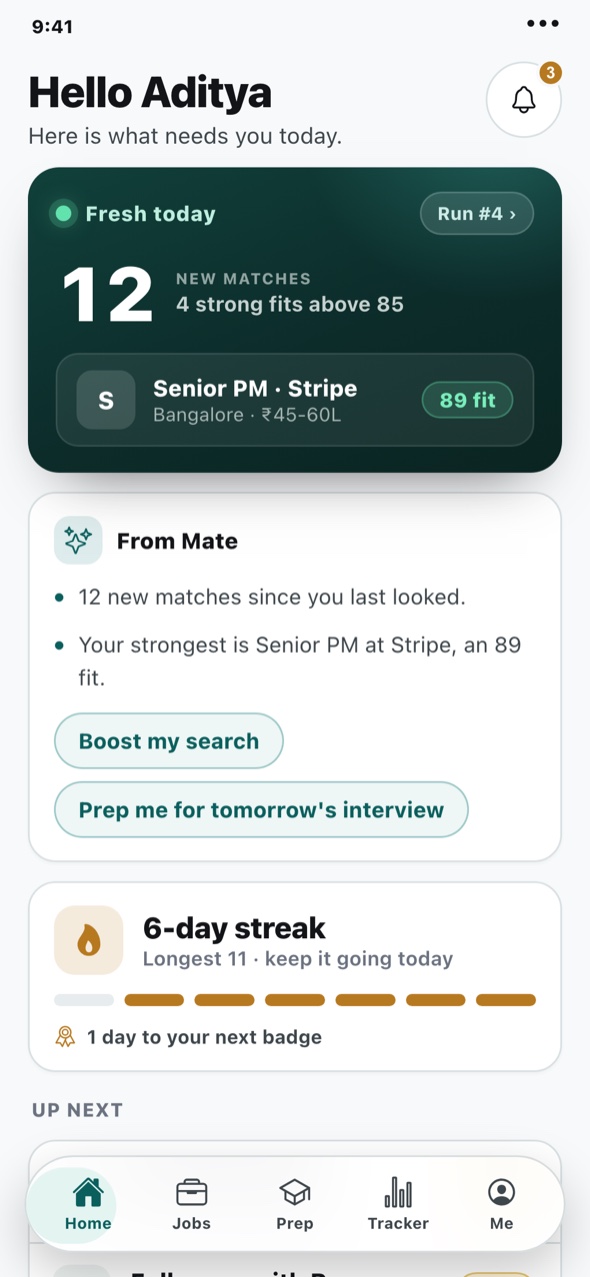
Product owner for NextJobMate, a multi-tenant AI SaaS for job discovery, CV tailoring, and interview prep, and NJM Egress, its companion Android networking product. Own strategy, architecture, the typed-outcome reliability contract, and cloud unit economics across Next.js web, Expo mobile, MCP, and a paired Chrome extension on a multi-tenant FastAPI/PostgreSQL backend.
18,775
Employer Feeds
28
ATS Platforms
58%
Cloud Cost Cut
Mar 2018 – Jan 2020
Helpen IT Solutions
SME Product Delivery Studio
Product Manager
Owned end-to-end product lifecycles for SME clients across agritech, fintech, and e-commerce. Led discovery, authored PRDs, and managed cross-functional delivery with engineering teams of 3-5 per client. Consistently reduced MVP time-to-market through rigorous scope control and stakeholder alignment.
3+
Verticals
Multi
Concurrent PRDs
↓
MVP Time-to-Mkt
Feb 2017 – Mar 2018
Helpen
One Stop Solution — 33 Apps in One
Founder & PM
Bootstrapped a consumer utility app from idea to 10K users with zero marketing spend. Identified a real user pain point, scoped the MVP, shipped in 3 months, and validated product-market fit before seeking capital. First proof of 0→1 execution ability.
33
Apps Unified
3 mo
MVP Delivery
10K+
First Users
Deep-Dive Case Studies
Six problems. Six structured solutions.
Restless VenturesSenior Product Manager
NextJobMate: AI Job Discovery at ATS Scale
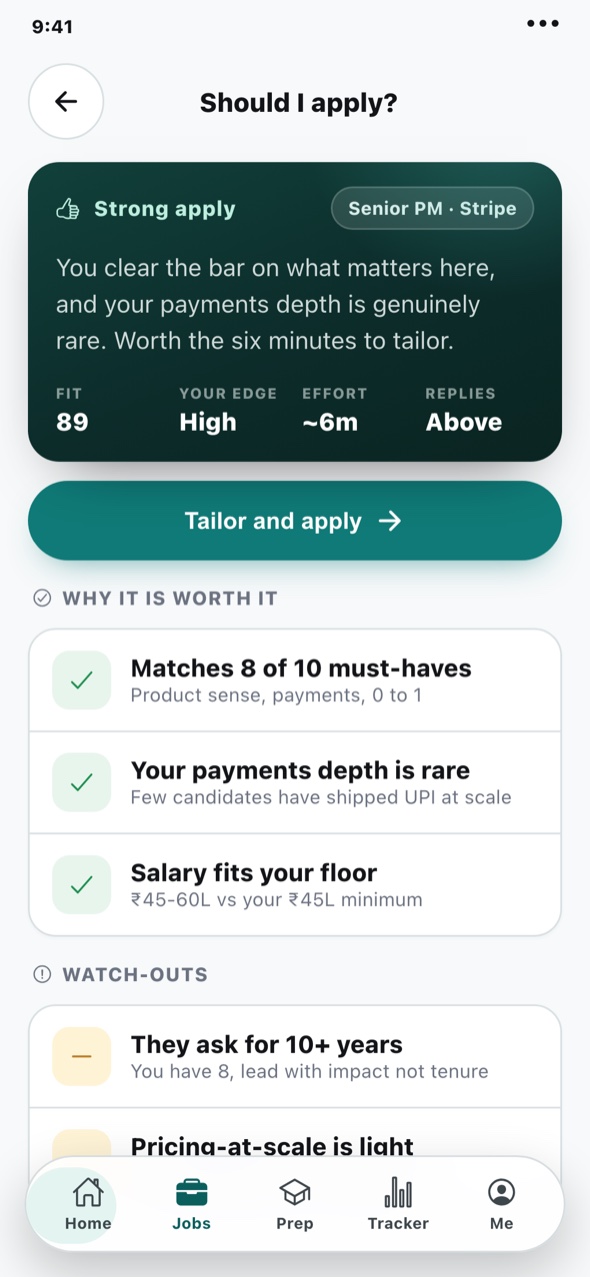
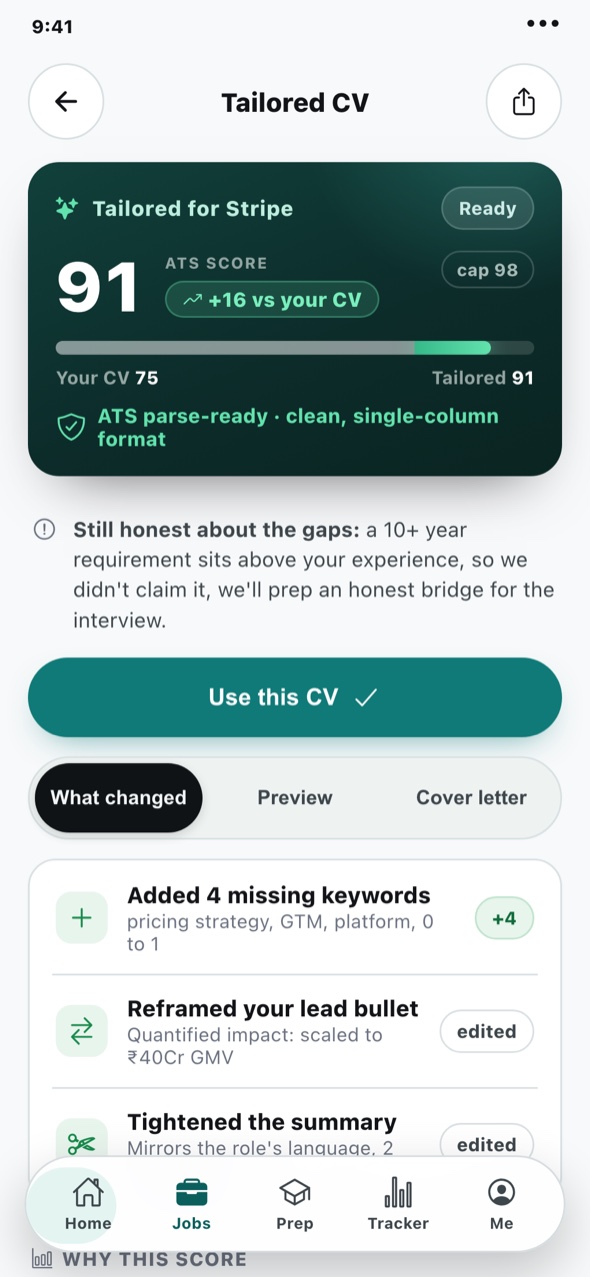
Job discovery is fragmented across boards that go stale, and a generic CV gets filtered out before a human ever reads it. NextJobMate closes both ends of that gap: it discovers roles across 12 public and ATS-direct sources, hydrates the full job description, scores fit, then produces a tailored CV, cover letter, and interview prep — with full provenance on every claim.
One multi-tenant FastAPI/PostgreSQL backend serves four surfaces: Next.js web, Expo mobile, MCP, and a paired Chrome extension. Direct feeds now reach 18,775 employers across 28 ATS platforms.
"Every dashboard reported healthy while end-to-end delivery was zero. Eight defects were hiding behind green — including a scoring component silently returning zero and deleting 30% of every score. We restored calibration rather than lowering the bar."
Shipped
✓ 12 discovery sources plus ATS-direct job feeds
✓ Typed-outcome reliability contract across all four surfaces
✓ AI cost ladder — deterministic gates and embeddings before inference
✓ NJM Egress — mesh networking, proxying, on-device IP rotation
✓ 8-phase AWS migration with zero downtime
Consciously Deprecated
– Authenticated scraping — a working capability
– Paid third-party egress vendor
Scraping was the wrong foundation for a paid product: ToS exposure, a single ban taking every user dark, and ops that would not scale. Discovery was rebuilt on public, partner, API, and ATS-direct lanes; the vendor was replaced by NJM Egress at $0 incremental cost.
58%
Cloud Run-Rate Cut
18,775
Employer Feeds
28
ATS Platforms
$0
Egress Vendor Cost
TricketSenior Product Manager
Building Tricket from Zero to One
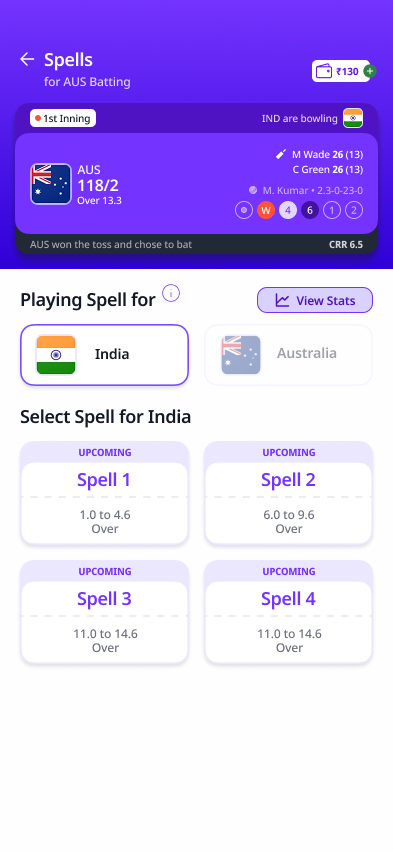
The traditional fantasy cricket market had a structural flaw: Time-to-Value (TTV) was 4–8 hours. You selected a full team of 11, waited an entire innings, and only then discovered your result. For 400M+ casual Indian cricket fans, this was simply too much of a commitment.
"The Spell format — predicting 4 consecutive overs rather than an entire innings — cut TTV from hours to under 30 minutes. This structural change, not a marketing campaign, drove the initial viral acquisition."
01
Defer KYC to withdrawal
Lifted install-to-registration from 45% (industry avg.) to 60% by moving identity verification to the withdrawal step.
02
Second-screen real-time engagement
Live over-by-over prediction sync that sustained a 25–30% DAU/MAU ratio (~30K/~110K).
03
GST absorption without user impact
Restructured backend financial routing to absorb 28% GST — maintained 20% net commission with zero change to user-facing fees.
04
High-concurrency architecture scoping
Defined requirements for a leaderboard serving 3M users with zero latency during peak IPL traffic.
05
LTV:CAC optimisation & retention loops
Gamified retention loops and organic referral programs that sustained 25–30% DAU/MAU ratio.
500K+
Downloads
300K+
Registered
60%
Conversion
~30K
DAU Peak
TricketAI Product Strategy
AI Prediction Engine & Bot Optimisation
Post-free gameplay, engagement fell off a cliff. The root cause was not poor product design — it was contest cancellations. Rooms were not filling to minimum participation thresholds, so contests were voided before they ran. Users who experienced a cancellation rarely returned.
The data told a starker story: bots were winning at only 9.85% vs humans at 36.59% — a 3.7× gap. Bots were too predictable, too static. Skilled users were gaming them systematically.
"The problem was not that bots were losing — it was that they were losing the same way every time. Predictable loss patterns killed the competitive tension that made contests worth entering."
Layer 1 — Historical Probability Engine
Weighted randomisation across probability ranges with 10–15% deviations into valid but less probable outcomes.
Layer 2 — Live Match Adaptation
Pre-spell recalibration using live score, run rates, and median cluster of real user predictions.
Layer 3 — Mid-Spell Reconfirmation Window
Bots re-evaluate when actual runs deviate beyond ±30% from expectation, with proportional adjustments.
9.85%→50%
Bot Win Rate Journey
3.7×
Human–Bot Gap (Eliminated)
TricketGamification & Monetisation
Tricket Coin (T-Coin) Reward System
New users on fantasy platforms face an immediate trust-commitment barrier. Asking for a wallet deposit before the user has experienced any product value is one of the fastest conversion killers in the category. T-Coins were designed to remove this entirely — giving users a risk-free path through real gameplay before any financial commitment was requested.
Wallet top-ups trigger T-Coin rewards — admin-configurable rate for promotions.
E3
Arcade Games
Luck-based mini-games for additional T-Coin earnings between live matches.
The Core Design Principle
"T-Coin exclusive rooms deliver an identical gameplay experience to paid rooms — same mechanics, same competition, same leaderboard tension — without touching the user's wallet. By the time we requested a deposit, users had already won multiple times."
100%
Win Guarantee
0
Wallet Friction
3
Earn Vectors
HelpenFounder & Product Manager
Helpen: 33 Apps in One Solution
In 2017, the majority of India's smartphone users were on 1–2GB RAM entry-level Android devices. The explosion of super-apps — Uber, Ola, Zomato, Amazon, Flipkart, Paytm and more — made it technically impossible to keep all services installed simultaneously.
The insight was architectural: these apps didn't need to be native installations — they needed to be accessible. A single lightweight host application serving 33 services via integrated webviews could eliminate the RAM constraint entirely, with one install replacing thirty-three.
"First principles: what does the user actually need? Not the apps — the services. The app is just the delivery mechanism. Remove the delivery overhead and you've solved the problem."
33
Services
3 mo
MVP Timeline
10K+
First Users
₹0
Marketing Spend
Helpen IT SolutionsProduct Manager
SME Product Delivery Across Sectors
SME clients in emerging markets typically arrive with a business problem, not a product brief. Led hypothesis-driven discovery, translated ambiguous objectives into modular engineering specs, and managed cross-functional teams of 3-5 across multiple concurrent client lifecycles — delivering working software within tight budget and timeline constraints.
🌾
Agritech
Supply chain and market access tools for farmers. Offline-first architecture for intermittent connectivity. Radically simplified UX for low digital literacy.
💰
Fintech
Lending and payments infrastructure for underserved SME segments. Regulatory compliance, full audit trails, UPI ecosystem integration.
🛒
E-Commerce
Catalogue management, order tracking, vendor management systems for regional operators competing against national platforms.
Helpen Shopping Hub — B2B E-Commerce (O2O)
Directed the 0→1 product strategy for a B2B e-commerce platform. Scaled a lean digital MVP into an Online-to-Offline (O2O) ecosystem, integrating digital demand generation with distributed physical operations across 4 retail nodes.
12%B2B Conversion Rate
4Retail Nodes Integrated
O2OUnified Architecture
What This Period Built
"Managing multiple concurrent product lifecycles for clients with fundamentally different domain constraints — where you can't copy solutions between them — is where systems-thinking and prioritisation discipline get sharpened fast."
Product management at its best is applied logic under uncertainty. I start with first principles, build hypotheses from data, and hold conviction loosely enough to update it. The job is not to be right — it is to be directionally correct, fast.
Technical Grounding
An early foundation as a software developer means I do not need a translator between myself and the engineering team. I scope API integrations, understand database schemas, and can identify when technical feasibility is being underestimated — or overestimated.
Constraint as Strategy
The most consistently bad product decision is trying to build too much. I treat constraints — budget, timeline, team size — as inputs to scope, not obstacles to it. Every MVP I've shipped has been defined by what we deliberately did not build.
Beyond the PM: The Writing Discipline
Published author of "99 Days and 6 Seconds... A Countdown to Forever" — a completed novel that demanded the same discipline as shipping a product: sustained structured thinking, rigorous editing, and knowing what to leave out. Currently writing a second book.
AI in My Product Workflow
I use AI tools daily as a product manager — not as a developer, but as an accelerator for PM execution:
‣
Rapid prototyping — using Replit and Claude to build functional prototypes for stakeholder demos before writing a single engineering spec
‣
PRD drafting & refinement — using ChatPRD and LLMs to generate structured PRDs, edge-case matrices, and acceptance criteria at 3x speed
‣
Data analysis — using AI to synthesise user research, parse analytics, and surface insights from large datasets
‣
Shipped an AI product — directed the development of Tricket's real-time AI prediction engine, defining the requirements and working hands-on with the engineering team to scope and deliver it
Currently Reading / Using
Inspired – Marty CaganThinking in BetsClaude OpusGeminiChatGPTCursor AIReplitChatPRDOllama · LM Studio
Get In Touch
Open to the right conversation.
Senior PM or Lead PM roles. Consumer tech, gaming, e-commerce, or anything with a complex problem at its centre. Based in Kolkata. Open to remote and relocation.